
Quick Summary
When plumbing leaks or severe flooding strike Hudson County properties, fast water damage restoration in Jersey City is critical to prevent severe structural decay across historic brownstones and modern high-rises. As the premier local emergency specialist, Wade's Restoration provides 45-minute dispatch with certified technicians who deploy tailored psychrometric drying protocols, advanced moisture mapping, and carrier-compliant claim documentation. Readers will learn how specific building materials are preserved and can contact Wade's Restoration 24/7 for immediate emergency water extraction or to schedule a free on-site structural inspection.
Water Damage Restoration in Jersey City: Emergency Response and Structural Drying
When a supply line bursts on an upper floor or storm water breaches your foundation, minutes matter. Wade’s Restoration provides emergency water damage restoration in Jersey City, dispatching equipped mitigation crews to extract standing water, map hidden moisture, and stabilize your property before structural damage escalates. Hudson County’s flood risk is the dominant hazard in the county’s disaster profile, with river, coastal, and surface flooding rated at the 99th percentile nationally. When water hits historic brick brownstones or modern waterfront concrete slabs, standard drying approaches are not enough. We bring the right psychrometric drying protocols directly to your door.[1]
From rapid structural stabilization to itemized insurance drying logs, our team manages the entire recovery process. Call our dispatch desk for emergency water extraction, or reach out to schedule an on-site structural moisture assessment. See also Water Damage Restoration in Weehawken – Call Now-10% Off – Same-Day Service – Free Estimate.
What to Do During a Jersey City Water Emergency
Immediate Action Checklist: Shut off the main water valve immediately, switch off electrical breakers supplying affected zones if you can access them safely, and call a certified restoration professional. Fast water extraction prevents microbial growth and stops water from wicking into subfloors and framing.
Immediate Safety Protocols
- Cut the Water Source: Turn off your main shutoff valve immediately to stop incoming flow. If you live in a multi-unit building and cannot locate your individual shutoff, notify building maintenance immediately.
- Isolate Electrical Hazards: If your breaker panel is in a dry area, shut down power to all flooded rooms. Never step into standing water in a basement or room where electrical outlets or appliances are submerged.
- Document the Scene for Insurance: Take clear, timestamped photos and video of standing water, damaged personal property, and affected building materials before water recedes or cleanup begins. Standard homeowners and renters insurance policies generally exclude flood damage. Meticulous photographic proof helps prevent disputed claims.
Initial Emergency Response On-Site
Once you call dispatch, an emergency response crew is mobilized. When water sits, it wicks vertically through drywall and seeps horizontally into shared wall cavities. Our certified technicians at Wade’s Restoration arrive on-site with extraction units, industrial submersible pumps, and thermal imaging cameras to halt the spread of moisture and begin active water removal.
The Topographic-Substrate Split: Historic Brownstones vs. Waterfront High-Rises
Jersey City features two distinct architectural realities, and drying them requires completely opposite psychrometric strategies. Applying high-rise drying methods to a historic brownstone can destroy original masonry, while treating a waterfront high-rise like a timber frame leaves moisture trapped under dense concrete assemblies.[5]
Downtown Brownstones: Porous Brick and Shared Party Walls
Historic rowhomes in Downtown Jersey City, Van Vorst Park, and along the Heights bluffs rely on soft, pre-war structural brick, lath-and-plaster walls, and porous fieldstone foundations. Jersey City has been identified in regional flood-loss modeling as one of the areas with especially high future rainfall-flood losses.[2]
When ground water or plumbing leaks hit these structures, capillary action pulls moisture sideways across shared brick party walls directly into neighboring units. If dried too aggressively with high-heat desiccant equipment, historic lime mortar can crumble. Wade’s Restoration deploys balanced Low-Grain Refrigerant (LGR) dehumidifiers paired with specialized cavity-injection drying systems. This introduces low-pressure, dehumidified air directly into shared wall cavities without damaging aged masonry or causing plaster delamination.
Waterfront High-Rises: Pressurized Risers and Below-Grade Slabs
Modern residential and commercial towers along Newport, Exchange Place, and Port Imperial present a different structural challenge. Water losses here often stem from high-pressure vertical riser failures or storm surges entering below-grade parking garages. Poured concrete decks and commercial soundproofing underlayments do not absorb water quickly; instead, they trap high volumes of liquid beneath luxury vinyl tile, engineered hardwood, or commercial carpet.
Trapped moisture on concrete creates an invisible reservoir that rots baseplates and travels down utility chases. To extract bound moisture from non-porous assemblies, we install industrial desiccant dehumidification setups. Desiccants produce exceptionally low relative humidity levels (sub-10 grain depression), pulling stubborn moisture out of concrete slabs and commercial assemblies before mold can take hold.
| Property Type | Primary Structural Vulnerability | Targeted Drying Strategy |
|---|---|---|
| Historic Brownstones & Rowhouses | Lateral capillary wicking through soft brick, fieldstone, and plaster party walls | LGR dehumidification with controlled low-pressure wall cavity ventilation |
| Waterfront High-Rises & Condos | Trapped moisture beneath flooring assemblies and across dense concrete slabs | Industrial desiccant drying systems delivering deep vapor pressure differentials |
What Structural Materials Can Be Restored vs. Replaced?
Need water damage restoration in Jersey City?
We’re available now - call for a fast, free estimate.
Determining what can be preserved depends on water category (clean supply line vs. contaminated storm or sewage backflow), duration of exposure, and material porosity. Our priority is always targeted restoration over unnecessary demolition.
Drywall, Plaster, and Ceilings
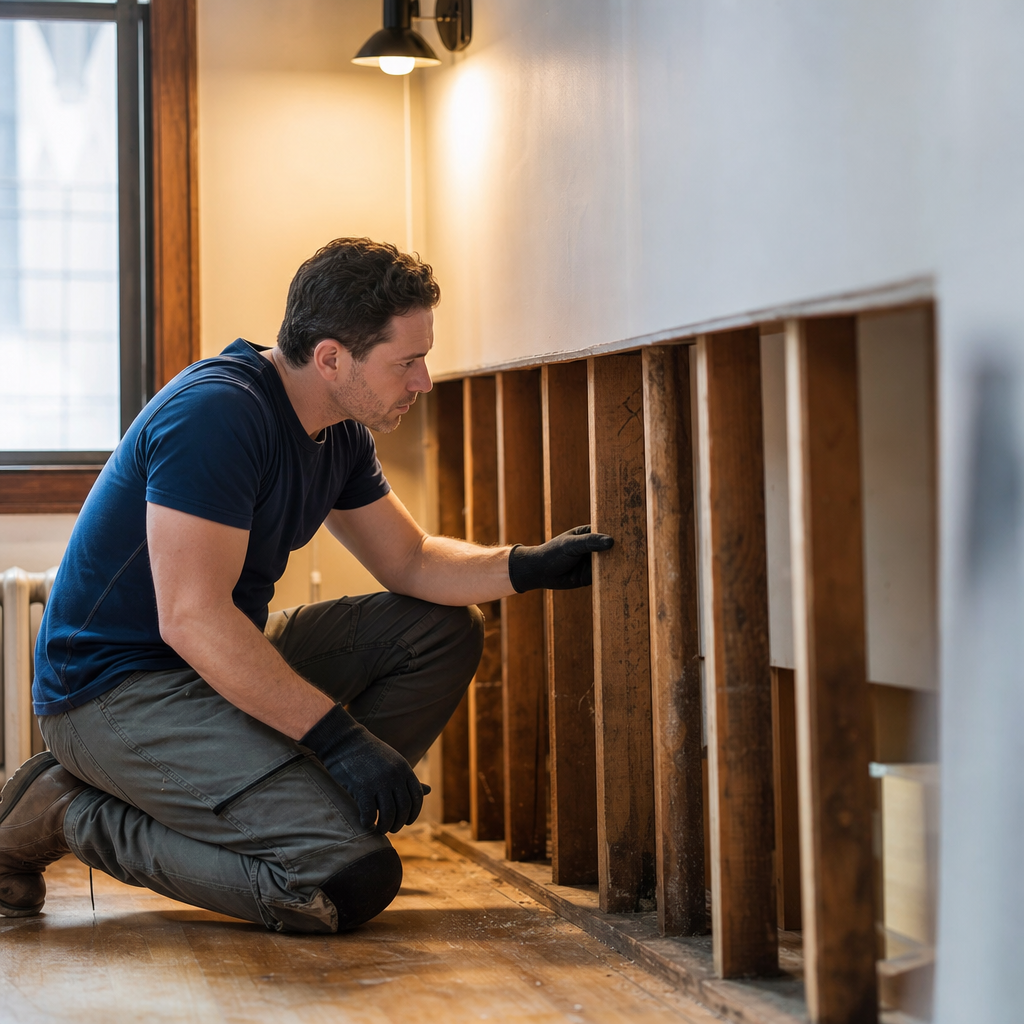
Standard drywall loses structural integrity when saturated. For clean water events, technicians make clean flood cuts roughly 12 to 24 inches above the highest moisture reading, preserving upper wall sections. In contrast, historic lath-and-plaster assemblies can frequently be dried in place using controlled dehumidification, provided the plaster keys have not detached from the wooden lath backing.[3]
Hardwood Flooring and Subfloors
Original solid hardwood flooring over timber joists can often be saved without tear-out if addressed quickly. We install specialized floor mat extraction systems that seal to the wood surface, using vacuum pressure to pull water directly through the grain. Conversely, floating engineered floors installed over closed-cell acoustic pads must usually be removed because trapped water cannot evaporate through the vapor barrier underneath.
Framing, Insulation, and Cabinetry
Heavy timber joists and structural wall studs can almost always be sanitized and dried in place. Wet fiberglass or cellulose insulation inside wall cavities must be removed immediately, as it compacts into a wet sponge that prevents drying and fosters mold. Solid wood cabinets can typically be dried in place, whereas saturated particleboard or MDF vanities swell permanently and require replacement.
Water Damage Restoration Costs in Jersey City
Restoration costs in Jersey City vary depending on the severity of the damage, the category of water contamination involved, and the specific structural materials affected.
Navigating New Jersey Homeowners Insurance Claims
Water claims can be complex. Standard homeowners policies generally exclude flood damage. Wade’s Restoration supports you throughout the adjustment process. Through our Claim Clarity workflow, our technicians maintain daily psychrometric logs, moisture mapping charts, and line-item photographic inventories formatted to meet standard carrier guidelines. This transparent documentation helps adjusters approve needed repairs promptly.
Frequently Asked Questions
How much does water damage restoration cost in Jersey City?
Water damage restoration costs vary based on the severity of the loss, the category of water contamination, and the specific materials requiring drying, removal, or repair.
How quickly can an emergency water restoration team arrive in Jersey City?
Emergency response teams from Wade’s Restoration are mobilized promptly for dispatch across Hudson County. Fast arrival stops moisture from migrating into subfloors, neighboring units, and shared wall assemblies.[4]
Does homeowners insurance cover water damage restoration in NJ?
Standard homeowners insurance policies generally exclude flood damage.
What steps are involved in the water extraction and drying process?
The restoration process follows the general steps of inspection and moisture mapping, water removal, removal of unsalvageable materials, structural drying, and monitoring.
How do I prevent mold growth after water damage or flooding?
Prompt physical water extraction, continuous airflow, structural dehumidification, and thorough moisture monitoring prevent mold from developing following a water loss.
Is sewage backup cleanup handled by water restoration professionals?
Yes. Sewage backups are classified as Category 3 (black water) emergencies containing dangerous biohazards, pathogens, and bacteria. Certified technicians establish negative air pressure containment, extract waste using specialized pumps, remove all non-salvageable porous materials, and sanitize the area with hospital-grade disinfectants.
Need water damage restoration in Jersey City?
We’re available now - call for a fast, free estimate.
Sources
- Current and Future Flood – njclimateresourcecenter.rutgers.edu (2025)
- [PDF] Current and Future Flood Exposure to New Jersey Properties and … – njclimateresourcecenter.rutgers.edu (2025)
- National Risk Index for Natural Hazards – fema.gov
- Section 5. Risk Assessment – nj.gov
- [PDF] a third of new jersey's public infrastructure at flood risk by 2050 – rebuildbydesign.org (2050)
Related reading: Water Damage Restoration in Hoboken – Call Now-10% Off – Same-Day Service – Free Estimate
Related reading: Water Damage Restoration in Astoria – Call Now-10% Off – Same-Day Service – Free Estimate
Related reading: Water Damage Restoration in Financial District – Call Now-10% Off – Same-Day Service – Free Estimate
Frequently Asked Questions
How long does structural water damage restoration typically take for Jersey City properties?
Most residential and commercial drying projects require three to five days, though saturated historic brick brownstones or dense high-rise concrete slabs may take longer. Wade's Restoration conducts daily moisture mapping and psychrometric monitoring to ensure all framing and substrates reach target dry standards before equipment removal.
What happens if water migrates through a shared party wall into an adjacent Jersey City building?
Because porous brick and timber in Downtown brownstones draw moisture laterally, our technicians use thermal imaging to assess neighboring units immediately. Wade's Restoration utilizes specialized low-pressure cavity-injection drying systems to stabilize shared wall assemblies without damaging historic mortar or requiring destructive demolition.
How does Wade's Restoration document water damage for New Jersey insurance claims?
Our team executes a structured Claim Clarity protocol, generating timestamped photographic evidence, detailed floor plans, and daily psychrometric drying logs formatted to industry standards. This comprehensive documentation provides adjusters with clear structural evidence to streamline coverage approvals and prevent claim disputes.
About the author
 |
Christopher Vance Christopher Vance is a property restoration specialist with over 10 years of experience in the disaster recovery industry. He holds a degree in Construction Management from Rutgers University and maintains certifications in structural drying and water damage restoration. Christopher focuses on creating practical guides that help Weehawken property owners navigate emergency mitigation and the complexities of insurance claims. |
Water damage, flood, or mold emergency?
We’re available now - call for a fast, free estimate.
Call Now - Free Estimate