
Quick Summary
Managing sudden water intrusions in Astoria requires rapid professional intervention to stop moisture from migrating deep into historic plaster, subfloors, and shared party walls. Wade's Restoration provides 24/7 emergency dispatch within 45 minutes, deploying IICRC-certified specialists who utilize negative-pressure cavity drying and end-to-end structural reconstruction. Property owners will understand how specialized drying prevents hidden mold, streamlines insurance claims through detailed psychrometric tracking, and enables immediate scheduling of a free visual inspection with Wade's Restoration.
Need Fast Water Damage Restoration in Astoria, NY?
When clean or contaminated water starts pouring through your ceiling, soaking your hardwood, or pooling behind kitchen cabinets, minutes count. Wade’s Restoration provides 24/7 live-dispatch emergency response across Astoria, getting an experienced crew to your property in under 45 minutes. We stop the water source, extract standing moisture, and provide a clear, written scope of work before turning on a single piece of equipment.
Water moves quickly through subfloors, joists, and older plaster assemblies. Waiting even a day allows moisture to wick deep into structural framing and creates prime conditions for mold growth. Instead of juggling multiple subcontractors or dealing with automated answering services, our IICRC-certified in-house team handles the entire process from emergency extraction and targeted cavity drying to complete drywall, floor, and structural rebuilds. Through our Claim Clarity Program, we also document every step with daily psychrometric logs and itemized photos to keep your insurance claim on track. See also Water Damage Restoration in Weehawken – Call Now-10% Off – Same-Day Service – Free Estimate.
At a Glance: Emergency Water Restoration in Astoria
Effective water damage restoration in Astoria requires rapid water removal, specialized cavity drying for older building materials, and end-to-end repairs to protect structural integrity. Certified technicians arrive with truck-mounted extractors, commercial dehumidifiers, and thermal cameras to locate hidden moisture pockets. Taking action within the first day halts moisture spread through shared party walls and protects your insurance coverage.
In multi-family and pre-war buildings, simply placing open-air box fans in a room often backfires by blowing moisture straight into shared wall cavities. Wade’s Restoration uses controlled, negative-pressure cavity systems and thermal imaging to draw trapped water out of structural framing safely while recording the exact data your adjuster needs.
How Fast Can Emergency Restoration Crews Arrive to Stop Water Damage?
Need water damage restoration in Astoria?
We’re available now - call for a fast, free estimate.
Our emergency restoration teams can arrive on-site within 45 minutes of your call. Technicians immediately shut off active water sources, pull standing water with high-volume extraction units, and set up containment zones to protect dry living spaces from airborne moisture or contaminants.
The first hour of an emergency determines whether saturated hardwood floors and plaster walls can be dried in place or have to be torn out completely. Fast physical intervention protects your building materials and lowers overall rebuild costs.
Immediate Containment and Water Extraction
When dealing with an active leak or sudden basement flood, strategic containment is just as important as extraction speed. In apartment buildings and attached row houses, setting up generic surface fans is a common mistake that pushes humid air directly into party walls and neighboring units. Our certified team follows a clear first-hour protocol:
- Source Isolation: Locating and shutting off fixture supply lines, hidden riser valves, or boiler feeds to stop the incoming flow.
- High-Volume Extraction: Using truck-mounted extractors to remove standing water from floors and carpet padding before it saturates subfloors.
- Thermal Perimeter Mapping: Scanning with infrared cameras and non-invasive moisture meters to pinpoint the exact moisture boundary behind baseboards and lath-and-plaster walls.
Preventing Category 2 and Category 3 Contamination
Water damage rarely stays clean for long. According to standards published by the Institute of Inspection, Cleaning and Restoration Certification, clean Category 1 water that sits in building materials can degrade into Category 2 gray water or Category 3 black water within 24 to 48 hours. Storm runoff and municipal drain backups introduce immediate biological hazards like bacteria, chemicals, and raw sewage.
Proper flood cleanup requires immediate environmental control. Our technicians apply EPA-registered antimicrobial treatments to prevent microbial growth on structural framing. When sewage backups or drain line failures occur, our crews isolate the affected areas using negative air machines equipped with HEPA filtration, preventing contaminated air from entering clean rooms during drying.
How Do Pre-War Structures Affect Drywall, Hardwood, and Cavity Drying?
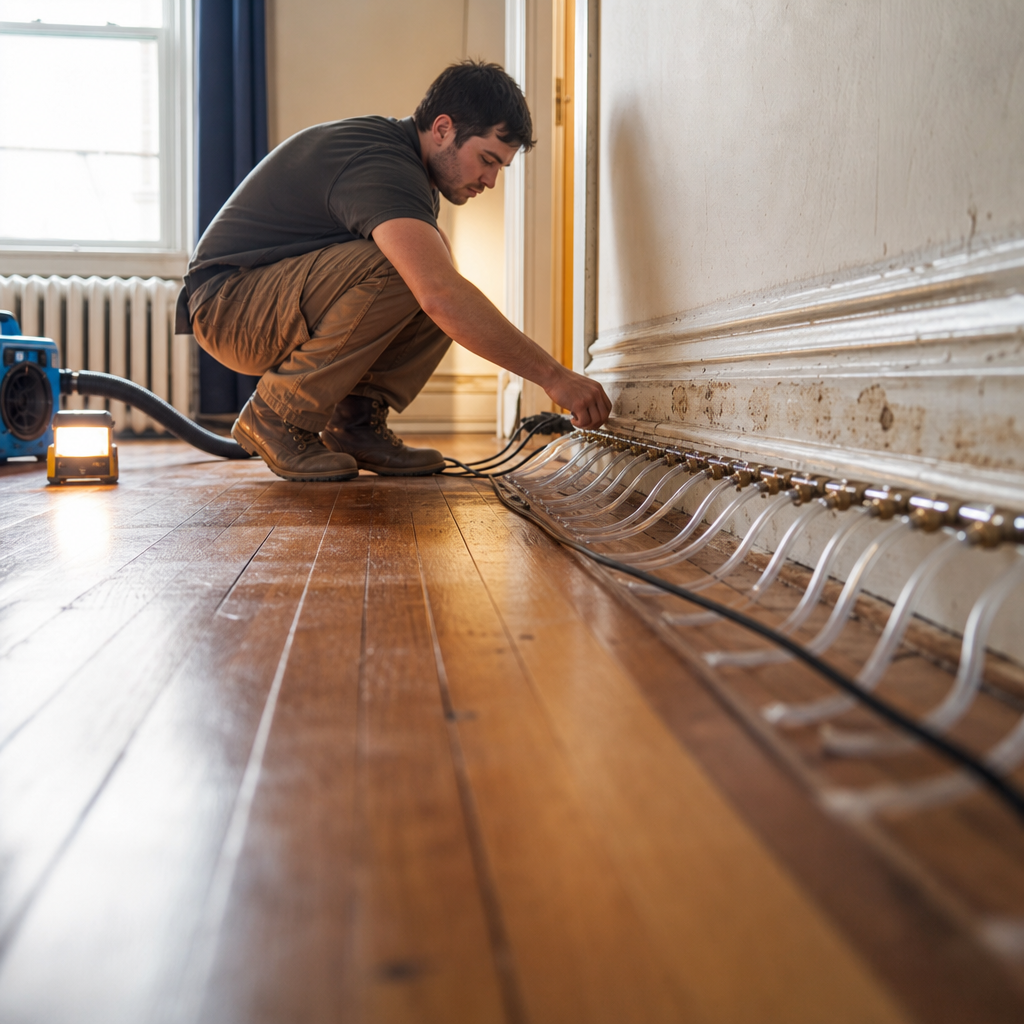
Pre-war buildings throughout Astoria feature dense assemblies like lath and plaster, solid brick masonry, and tongue-and-groove subfloors that hold onto moisture. Unlike standard modern drywall, these historic materials resist basic surface evaporation and require specialized intra-cavity injection drying, negative pressure, and commercial desiccant systems to prevent hidden rot.
The Problem with Open-Air Drying Fans in Shared Party Walls
Setting up standard residential floor fans in older multi-family properties can make hidden damage worse. High-velocity surface air creates an unbalanced vapor pressure gradient across wet plaster. Instead of pulling water out, it forces moisture deeper into porous brick, uninsulated joist bays, and shared party wall chases, which can push humidity and musty odors directly into neighboring apartments.
Trapped moisture inside unvented cavities can trigger active fungal colonies within one to two days. Rather than relying on subcontractors or basic room blowers, Wade’s Restoration uses directional wall-cavity injection systems. These tools pull moist air out under controlled negative pressure while exhausting air through HEPA filters to protect surrounding living areas.
Targeted Drying for Subfloors, Joists, and Plaster Assemblies
Proper water damage restoration in Astoria requires knowing whether building materials have surface-level dampness or deep structural saturation. For example, cupping hardwood floors can frequently be saved without full replacement if testing shows the underlying subfloor remains solid and structurally sound.
| Structural Assembly | Standard Modern Approach | Pre-War Multi-Family Approach |
|---|---|---|
| Plaster and Lath Walls | Flood-cut drywall 12 inches above the waterline | Non-invasive cavity drying using penetrating thermal imaging and injector ports |
| Hardwood and Subfloor | Immediate tear-out of planks | High-pressure suction mat systems to extract water bound deep in subfloors and joists |
| Masonry Party Cavities | Open ambient dehumidification | Negative-pressure desiccant airflow to pull moisture out of dense brick wythes |
Using deep-penetrating moisture meters and calibrated infrared cameras, our technicians find moisture trapped behind thick plaster. Through our Claim Clarity Program, we record daily moisture logs and visual proof to show complete structural dryness to your insurance adjuster, protecting the building’s architectural integrity while preventing mold growth.
What Does Water Damage Restoration Cost in Astoria?
Need water damage restoration in Astoria?
We’re available now - call for a fast, free estimate.
Restoration costs depend on the water source category, the total square footage affected, and the types of materials involved. A minor clean-water supply line leak on tile represents a straightforward extraction, whereas sewage backups or saturated plaster walls require more extensive mitigation, containment, and structural drying.
Comparing Drying Methods for Multi-Family Properties
Total restoration costs reflect the water category (clean, gray, or black water) and how deeply moisture has entered building assemblies. Choosing the right drying technique from the start prevents costly secondary tear-outs and mold remediation down the road.
| Feature | Standard Open-Air Fans | Conventional Dehumidifiers | Directed Cavity Drying |
|---|---|---|---|
| Safe for Pre-War Party Walls | No (pushes moisture inward) | Partial | Yes (uses negative suction) |
| Deep Plaster Extraction | No | No | Yes |
| Prevents Shared Cavity Mold | No | Partial | Yes |
| Insurance Log Compliance | No | Yes | Yes |
Using basic open-air fans in older structures often increases repair bills later on. Uncontrolled airflow drives moisture into party wall voids, creating hidden mold colonies that require costly remediation long after the original leak is gone.
Managing Insurance Claims with Itemized Documentation
Getting your insurance claim approved quickly depends on providing clear, itemized records from the very first day. Wade’s Restoration helps keep the claims process smooth through our Claim Clarity Program:
- Detailed Line-Item Scopes: Documenting the exact boundaries of active water damage with thermal images to prevent carrier disputes.
- Daily Moisture Tracking: Recording relative humidity, grains per pound (GPP), and psychrometric readings aligned with industry restoration standards.
- Full Project Continuity: Managing the job from emergency extraction through final reconstruction with one dedicated team, eliminating subcontractor delays.
For dependable water damage restoration in Astoria, call Wade’s Restoration for 24/7 live-answer dispatch, 45-minute on-site arrival, and a free visual inspection with an upfront written scope of work.
Frequently Asked Questions About Water Restoration in Astoria
Professional water damage restoration protects your property value, halts mold growth, and restores living spaces safely. Most residential drying projects take between three and five days under proper containment. Here are answers to common questions about the restoration process.
Does property insurance cover water extraction and repairs?
Most standard homeowners and commercial property policies cover sudden and accidental water discharges, such as burst pipe supply lines or broken appliance hoses. Rising groundwater or external street flooding typically requires a separate flood policy through the National Flood Insurance Program (NFIP). Wade’s Restoration provides itemized photo logs, moisture maps, and drying logs to help your adjuster process the claim smoothly.
How long does structural drying take in multi-family buildings?
Structural drying typically takes 3 to 5 days under controlled temperature and humidity conditions. In older multi-family properties with plaster walls and dense subfloors, standard open-air fans can trap damp air inside shared wall chases. Our team uses negative-pressure cavity systems and commercial LGR dehumidifiers to remove moisture without damaging neighboring units.
Can hidden water damage trigger toxic mold?
Yes. Water trapped behind dense plaster, underneath baseboards, or inside insulation can foster mold colonies within 24 to 48 hours. Our in-house team handles both water extraction and structural drying under negative air containment, stopping mold spores from traveling between rooms or into shared building cavities.
Need water damage restoration in Astoria?
We’re available now - call for a fast, free estimate.
Frequently Asked Questions
Can cupped hardwood floors in older Astoria properties be salvaged after water saturation?
Yes, hardwood flooring often does not require a complete tear-out if structural drying begins before wood fibers permanently warp. Wade's Restoration utilizes high-pressure suction mat systems and thermal imaging to extract trapped moisture directly from dense pre-war subfloors and joists.
How does Wade's Restoration prevent water damage from spreading to neighboring multi-family units?
Rather than using open-air fans that push humid air into shared party wall chases, our certified technicians install negative-pressure cavity drying systems. This controlled method draws moisture out of wall voids under HEPA containment, preventing cross-unit moisture migration and odor transfer.
What specific documentation does the Claim Clarity Program provide for insurance adjusters?
Wade's Restoration provides daily psychrometric tracking logs, grain-per-pound (GPP) calculations, and thermal perimeter maps that verify the precise boundary of moisture intrusion. This detailed, line-item evidence demonstrates proper drying standards to your insurance carrier to help expedite claim approval.
About the author
 |
Christopher Vance Christopher Vance is a property restoration specialist with over 10 years of experience in the disaster recovery industry. He holds a degree in Construction Management from Rutgers University and maintains certifications in structural drying and water damage restoration. Christopher focuses on creating practical guides that help Weehawken property owners navigate emergency mitigation and the complexities of insurance claims. |
Water damage, flood, or mold emergency?
We’re available now - call for a fast, free estimate.
Call Now - Free Estimate