
Quick Summary
Acute coastal storm surges, sewer backups, and high-rise pipe bursts in Lower Manhattan present severe structural risks that require immediate containment to prevent widespread secondary damage. Wade's Restoration provides elite, rapid-response emergency water damage restoration in Lower Manhattan, utilizing advanced thermal imaging, high-capacity water extraction, and targeted structural drying to halt moisture migration across multi-unit buildings. Readers will understand essential safety protocols for flood crises and can call 24/7 for immediate emergency water extraction dispatch and a free on-site visual inspection to accelerate insurance claim recovery.
Emergency Water Damage Restoration in Lower Manhattan
When water floods a residential loft in TriBeCa or a commercial office near Wall Street, minutes matter. Water spreads rapidly through flooring, wicks up drywall, and seeps into ceiling plenums below. Lower Manhattan presents unique structural and environmental challenges, including acute coastal flooding, chronic flooding from sea-level rise and extreme rainfall, and sewer-system overload. By the 2050s, projections indicate that 37% of properties in Lower Manhattan will face risks from a 1% annual-chance storm surge. Whether you are dealing with a burst high-pressure riser on the twenty-second floor or coastal water surging into a sub-grade mechanical room, securing immediate emergency water damage restoration in Lower Manhattan is essential to protect structural integrity and limit financial liability.[1]
Professional restoration teams, such as Wade’s Restoration, focus on immediate water extraction, rapid stabilization, and moisture assessment. For property managers, co-op boards, and building owners, rapid intervention limits secondary damage and prevents water from migrating into neighboring units. See also Water Damage Restoration in Weehawken – Call Now-10% Off – Same-Day Service – Free Estimate.
What to Do During a Lower Manhattan Water Emergency
During an active water intrusion, personal safety comes first. High-volume pipe bursts and localized flash floods introduce electrical and structural risks that must be addressed before cleanup begins.[5]
Immediate containment and safety protocol
- Eliminate immediate hazards: Call 911 if water threatens electrical panels, main switchgear, or gas lines, or if structural framing shows signs of bowing or collapse.
- Shut off the source: If safe and accessible, shut off the main water isolation valve for the unit or riser. In large multi-family buildings, alert building super-staff immediately.
- Avoid standing water: Never walk through standing water if power is still active in the unit. Sub-grade floodwaters and sewer backups carry biohazards, requiring personal protective gear.
- Protect contents and document damage: Lift furniture onto foil blocks or wood risers if feasible. Take clear photos and video of all standing water, damaged personal property, and building materials before any tear-out begins.
When to contact emergency dispatch
Contact qualified restoration professionals like Wade’s Restoration as soon as the water source is identified. Approximately 84.6% of Manhattan’s housing stock in the cited inundation analysis was built before 1980. Older plumbing systems, combined with aging plaster and timber assemblies, absorb moisture rapidly. Calling dispatch immediately helps enable mitigation before moisture spreads further through structural assemblies and tenant boundaries.
How Fast Can Emergency Restoration Teams Arrive in Lower Manhattan?
Any stated arrival times represent unverified company-specific service promises that must be confirmed directly with the service provider. Actual transit and response times in downtown Manhattan depend heavily on real-time traffic conditions, street closures, and the physical logistics of the building.
Navigating dense Manhattan traffic and parking logistics
Staging restoration equipment in areas like the Financial District, South Street Seaport, or SoHo involves navigating narrow cobblestone side streets, active loading docks, and strict Department of Transportation parking rules. Downtown mitigation crews coordinate directly with building security and property managers to secure freight elevator access, clear basement corridors, and run containment lines without blocking emergency exits or fire lanes.
Moisture extraction considerations
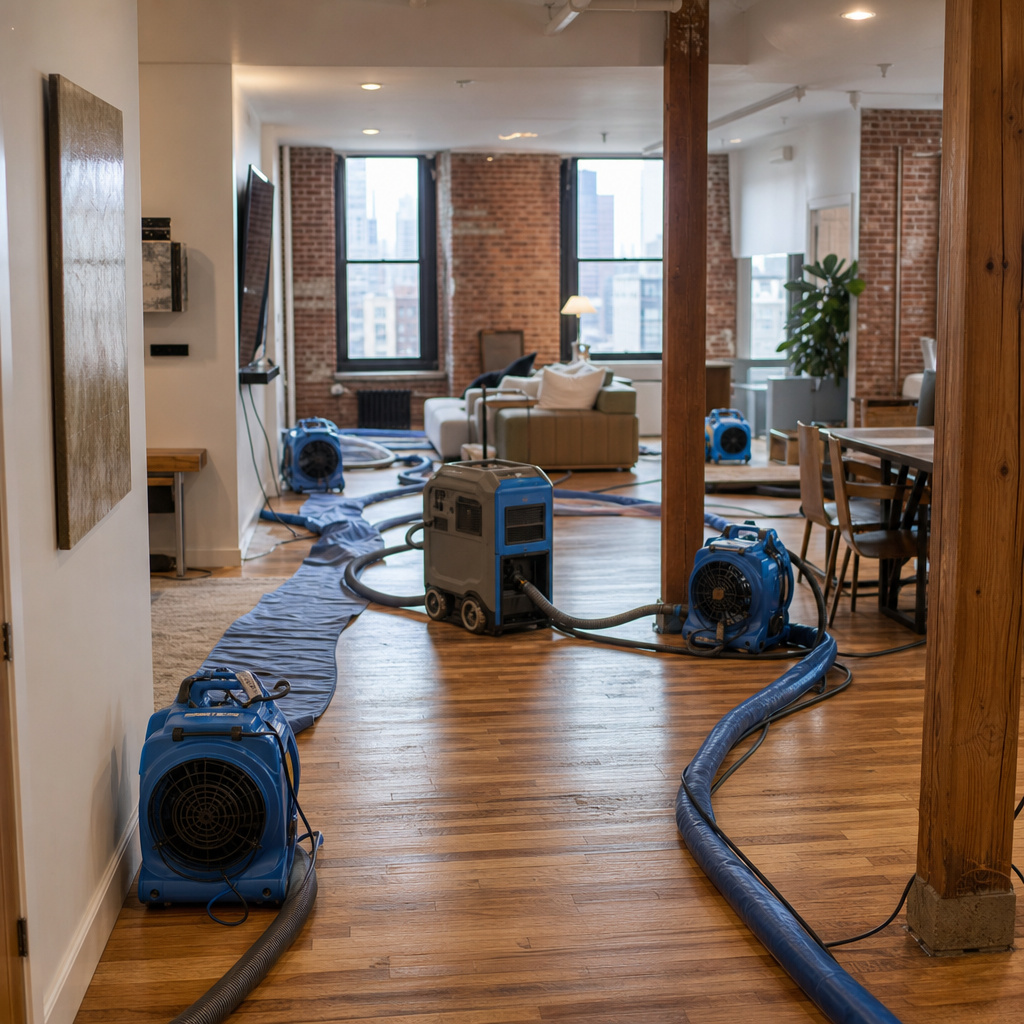
Pre-war masonry, historic timber beams, and concrete floor slabs hold water differently than modern light-gauge steel construction. Structures require controlled drying suited to their materials. Restoration professionals, including teams from Wade’s Restoration, typically utilize tools such as moisture meters and thermal imaging to assist in evaluating moisture across affected structural surfaces.
What Does Emergency Water Damage Restoration Cost in Lower Manhattan?
Need emergency water damage restoration in Lower Manhattan?
We’re available now - call for a fast, free estimate.
The cost of emergency water mitigation varies widely depending on the water source, contamination level, the volume of water extracted, and how far moisture has migrated through structural assemblies.
Key cost factors
- Water contamination category: Clean water from a broken supply line (Category 1) requires less labor and containment than greywater from appliance overflows (Category 2) or blackwater from storm surges and sewer backups (Category 3), which involves specialized sanitization and safety procedures.
- Square footage and vertical displacement: A localized leak confined to a single room is far simpler to remediate than a pressurized line break that cascades through multiple floors of a building.
- Structural drying needs: Historic plaster, multi-layered subfloors, and commercial-grade carpet over concrete slabs often require specialized dehumidification and containment setups depending on the extent of saturation.
Environmental conditions also play a major role in regional property risk. According to the New York City Mayor’s Office of Climate and Environmental Justice, projected groundwater-table rise could put 7% of Lower Manhattan buildings at risk of structural destabilization by 2100, while exposing 39% of streets with underground utilities to chronic infiltration. The New York City Flood Hazard Mapper provides official information on current coastal flood hazards and projected changes under climate change.[2]
How Vertical Water Migration Threatens High-Rises and Historic Buildings
In dense multi-family buildings and commercial high-rises, vertical water migration presents substantial risk. Water follows gravity down electrical conduits, plumbing chases, elevator shafts, and expansion joints. Ineffective drying setups can fail to address trapped moisture within shared cavities, potentially affecting adjacent units.[3]
Drywall, ceilings, and shared structural utility chases
When water escapes on an upper floor, it quickly pools on the subfloor and enters vertical pipe penetrations. From there, it can saturate ceiling drywall, insulation, and conduit runs of the units below. In pre-war co-ops, water often travels along horizontal joists before dropping down inside common demising walls. If trapped moisture inside these chases is not properly addressed, secondary water damage and mold growth can develop inside wall cavities.
Hardwood flooring, subfloors, and concrete slab saturation
Hardwood flooring laid over concrete slabs can trap moisture in the underlayment, potentially leading to cupping, buckling, or separation. During historic storm events, coastal surges compound this issue. When Hurricane Sandy struck, storm surges flooded 17% of New York City land and caused roughly $19 billion in damage. Proper mitigation requires evaluating moisture retention in structural slabs and underlayments before installing replacement finishes.[4]
Mitigation methods for multi-unit buildings
- Targeted containment: Technicians may set up plastic containment barriers and air filtration units to isolate work zones from common hallways.
- Cavity and structural drying: When appropriate, specialists utilize targeted drying techniques to address moisture in wall cavities and chases.
- Documentation and moisture tracking: Technicians record environmental conditions and material moisture readings to monitor the drying process.
Frequently Asked Questions
Does insurance cover emergency restoration costs and flood damage?
Insurance coverage depends on the cause of the water damage and the specific policy terms. Standard homeowners and unit policies generally exclude flood damage. Certain flood, water-backup, or sewage losses may require coverage through the National Flood Insurance Program (NFIP) or specific policy endorsements. Commercial policies must be reviewed individually to confirm applicable coverage, sub-limits, and deductibles.
How do restoration professionals prevent mold after a pipe burst in high-rise buildings?
Restoration teams, including Wade’s Restoration, mitigate mold risks by extracting bulk standing water promptly, establishing airflow and dehumidification to dry affected structural materials, and addressing trapped moisture within shared walls and chases.
How do I know if my building requires structural drying versus complete tear-out?
Moisture assessment tools help professionals evaluate the extent of water penetration in building assemblies. Depending on the water category, duration of exposure, and material porosity, materials may either be dried in place or require removal and replacement based on professional assessment.
Disclaimer: Arrival times, service scope, certifications, pricing, and insurance handling must be confirmed directly with the restoration company and insurer.
Need emergency water damage restoration in Lower Manhattan?
We’re available now - call for a fast, free estimate.
Sources
- Lower Manhattan Climate Resilience Study – NYC.gov – nyc.gov (2050)
- LOWER MANHATTAN COASTAL RESILIENCY – nyc.gov (2021)
- PowerPoint Presentation – nyc.gov
- Ten Years After Sandy – New York City Comptroller – NYC.gov – comptroller.nyc.gov
- Floods and Recurrence Intervals | U.S. Geological Survey – usgs.gov
Related reading: Emergency Water Damage Restoration in Long Island City | Call Now-10% Off | On-Site in 60 Minutes | Free Estimate
Related reading: Drywall Water Damage Repair in Astoria – 10% Off & Free Estimate – On-Site in 60 Minutes
Related reading: Water Damage Restoration in Hoboken – Call Now-10% Off – Same-Day Service – Free Estimate
Emergency Water Damage Restoration in Nearby Cities
We also serve the communities around Lower Manhattan:
- Emergency Water Damage Restoration in Weehawken
- Emergency Water Damage Restoration in Astoria
- Emergency Water Damage Restoration in Financial District
- Emergency Water Damage Restoration in Hoboken
- Emergency Water Damage Restoration in Jersey City
Frequently Asked Questions
How does Wade's Restoration assist with insurance claim recovery after a flood or pipe burst?
Wade's Restoration provides comprehensive moisture mapping, thermal imaging records, and itemized photographic logs of all affected structural materials. This detailed technical documentation streamlines the claims process with your insurance provider, ensuring all emergency extraction and drying costs are properly accounted for.
What happens when vertical water migration affects multiple floors in a Lower Manhattan building?
Wade's Restoration deploys targeted cavity-drying systems and industrial dehumidifiers to address water traveling through shared utility chases, electrical conduits, and pre-war subfloors. Our technicians set up plastic containment barriers to protect common areas and isolate moisture before secondary damage reaches neighboring units.
How do I request 24/7 emergency water extraction dispatch in Lower Manhattan?
Property managers and homeowners can call Wade's Restoration 24/7 to initiate immediate emergency dispatch across Lower Manhattan. Our rapid-response teams arrive equipped to navigate downtown logistical hurdles and perform a free on-site visual inspection before beginning high-capacity water extraction.
About the author
 |
Christopher Vance Christopher Vance is a property restoration specialist with over 10 years of experience in the disaster recovery industry. He holds a degree in Construction Management from Rutgers University and maintains certifications in structural drying and water damage restoration. Christopher focuses on creating practical guides that help Weehawken property owners navigate emergency mitigation and the complexities of insurance claims. |
Water damage, flood, or mold emergency?
We’re available now - call for a fast, free estimate.
Call Now - Free Estimate